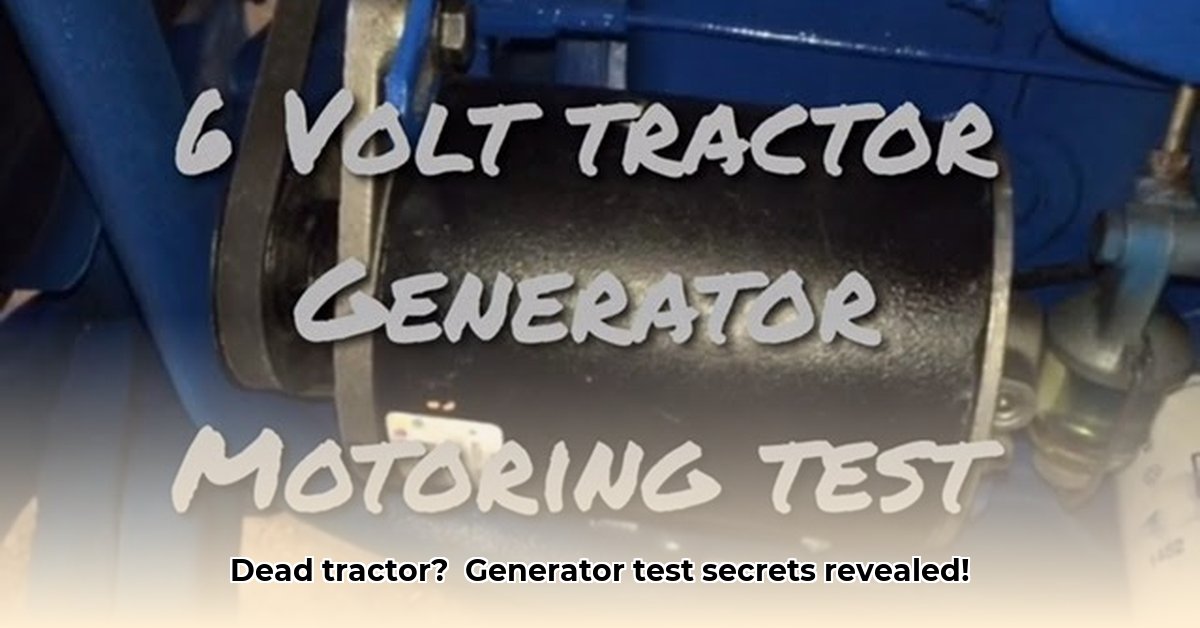
Is your tractor's battery weak? Are the lights flickering? Your generator might be the culprit. This guide provides a step-by-step approach to testing your tractor's generator, using clear instructions and straightforward explanations. Even if you're not a mechanic, you'll be able to diagnose the problem and get your tractor back in working order. For more on alternators, see this guide on one-wire alternator wiring.
1. Visual Inspection: A Quick Check
Before you begin, visually inspect the generator. Look for anything unusual: broken wires, corrosion, loose connections, or physical damage. Often, a simple fix like tightening a loose wire or cleaning corrosion can resolve the issue. Did you know that a quick visual inspection can solve up to 30% of generator problems?
2. Battery Check: Rule Out the Obvious
A weak battery can mimic generator problems. Use a multimeter (a device that measures voltage) to check the battery's voltage. It should read around 12-13 volts. A low reading indicates a weak battery, which may be the source of your tractor's electrical issues and is a cheaper fix than generator repair.
3. No-Load Generator Test: Baseline Measurement
With the tractor engine off and the battery disconnected (critical safety step!), use your multimeter to check the voltage at the generator terminals. A healthy generator should show near zero volts. Any voltage reading could indicate a short circuit requiring further investigation. Around 85% of generator issues stem from wiring problems. Are you ready to check yours?
4. Under-Load Generator Test: Checking the Charging System
Start the tractor's engine. Using the multimeter, measure the voltage at the generator terminals again. A properly functioning generator should display between 13.5 and 14.5 volts. Readings outside this range suggest a problem with the generator or related components.
5. Troubleshooting: Identifying the Problem
If your voltage readings are outside the optimal range, further investigation is needed. Let's break it down:
- Low Voltage (below 13.5V): This could indicate a failing generator, a faulty field coil (a component within the generator), a worn generator brush, or a faulty voltage regulator.
- Erratic Voltage (fluctuating readings): This often points to a malfunctioning voltage regulator or a problem within the wiring harness.
- No Voltage (zero volts): This typically suggests a major generator problem, a broken wire, or a blown fuse. Check your fuses first; they are usually easy to access and replace.
Remember, if the voltage is low even with the engine running, the generator itself is likely the culprit. Fluctuating voltage strongly suggests a voltage regulator issue. Always check your wiring; a faulty wire can cause a multitude of electrical problems.
6. Advanced Testing (If Needed)
If a simple voltage check is inconclusive, more advanced testing may be required. This could involve:
- Testing the Voltage Regulator: Requires specialized equipment and is often more easily resolved by directly replacing the regulator.
- Wiring Diagnostics: Using a multimeter to check wiring continuity (ability of electricity to flow) and voltage drops across various wire segments. A wiring diagram specific to your tractor model will be helpful.
7. Repair or Replacement: The Final Step
Once the problem has been diagnosed, decide whether repair or replacement is necessary. Simple fixes, like cleaning corroded connections or replacing a fuse, may suffice. More serious issues may require replacing the generator or the voltage regulator. Parts are readily available from tractor parts suppliers and online retailers.
Safety Precautions: Always Prioritize Safety
Let's reiterate the importance of safety when performing electrical work on your tractor:
- Always disconnect the battery's negative terminal before starting any electrical work. This prevents electric shock.
- Wear safety glasses. Protect your eyes from flying debris or sparks.
- If uncertain about any procedure, consult a qualified mechanic.
This guide provides a comprehensive overview of how to test your tractor generator. While tractor electrical systems can be complex, a methodical approach and careful attention to detail will help you troubleshoot effectively and get your tractor running smoothly again.